 Amwayi
What I keep noticing
A determined person holds a view most people reject. They keep working and they succeed. Then society calls the result evil.
I think evil is often the name for what normal people cannot deal with or put into words. This is my opinion. I have not tested it against anything beyond what I have seen and read.
A label costs one sentence
If you think a view is harmful, you have work to do. You organize. You write. You raise money. You build a better option. You show up again next month.
A label takes one sentence. It feels like action and it changes nothing. The person you labeled keeps working and you move on to the next thing.
So I ask the question I rarely hear. Why does society not become as determined as the person it fears, and deal with the issue?
Good people get the label too
Determined people who solve real problems also get called wrong or dangerous. Two examples, as I know them from commonly told accounts, not from primary records.
Ignaz Semmelweis told doctors in Vienna in the 1840s to wash their hands. Deaths in his clinic fell from about 18 percent to about 2 percent. Many colleagues rejected him.
Wangari Maathai started a tree-planting movement in Kenya in 1977. Officials dismissed her. She was arrested and beaten by police during protests in the early 1990s. She won the Nobel Peace Prize in 2004.
One reason may be competition. A person who fixes a problem shows that others could have fixed it too. A label removes that discomfort and leaves the problem where it was.
Determination does not prove someone is right. Some determined people do cause harm, and then the label is fair. So I try to judge the evidence, not the crowd.
Will and force
A line I wrote in my notes: most men think themselves strong, but they are instruments of other people’s will. Your habits, your employer, your crowd and your tradition all push on you. Many people carry out those pushes and call them their own choices. Ask whose will you are acting on today.
Now look at the other side. When you push your will onto someone and it fails, violence begins. Force is what people reach for when persuasion runs out. History has many cases of religious and political groups that moved to force once people refused to believe or obey. I am generalizing here, and I know some cases do not fit.
A strong will with a gentle push
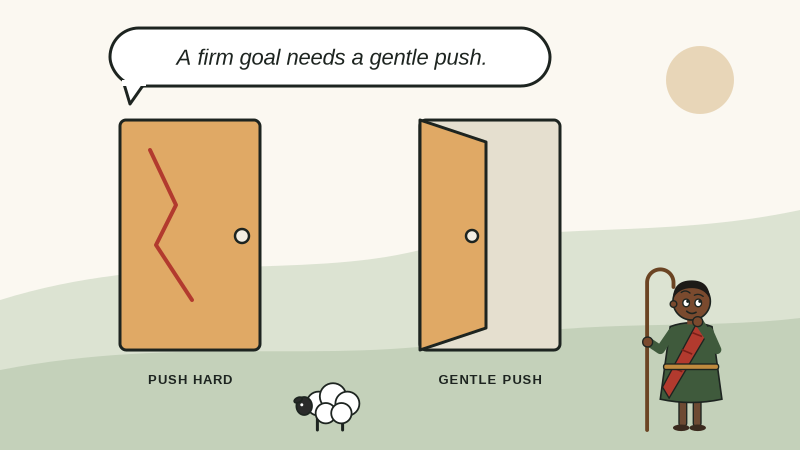
Hold your goal firmly. Apply it gently. A gentle push leaves the other person room to move toward you. A hard push gives them a reason to push back.
Watch for one risk. When the path to victory looks clear to me, that clarity can hide other truths. I have felt it. The remedy I know is to ask someone who disagrees with me what I am missing, and then listen.
Power in giving way
Someone who gives up power gently deserves to hold it. They have shown they do not need it.
There is a second point. Most people do not want to lose, so when someone yields, they read it as a win and lower their guard. A person who yields on one point can use that moment to keep what matters most. Yielding in that way is a choice, not a defeat.
I keep one limit in view. If I only pretend to yield so I can disarm someone, I am manipulating them. People notice, and they will not trust me again. I should yield only what I can afford to lose.
What I took from it
- A label takes one sentence. Dealing with the problem takes years. Do the work before you name the person.
- Determination does not make someone right or wrong. Check the evidence, not the crowd.
- Ask whose will you are acting on. Many of my choices are pushes I never examined.
- When pushing fails, stop and ask what the other person needs before you push again.
- Yield what you can afford to lose. Do not pretend to yield as a trick.
Comments