What it is
An Idempotent Settlement and Reconciliation Engine, invoice financing as the first
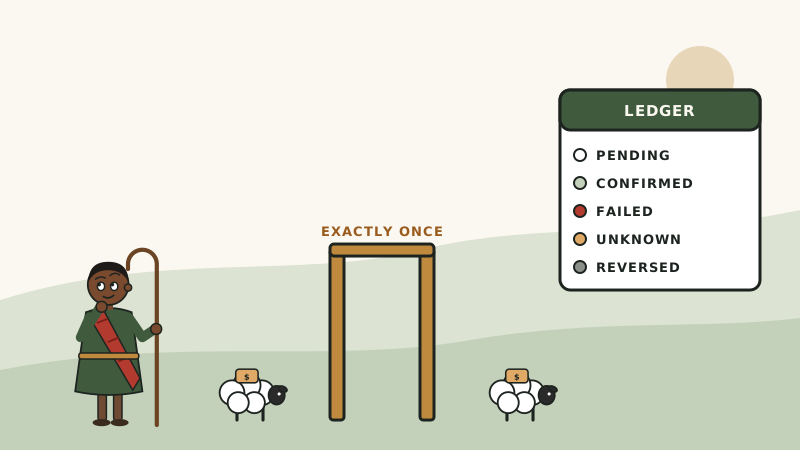
application on top of it. Built by Miguel with Claude Code. The core guarantees exactly-once
money movement on top of a network that only guarantees at-least-once delivery: every
settlement request is idempotent, every settlement has an explicit state (PENDING,
CONFIRMED, FAILED, UNKNOWN, REVERSED), and a reconciliation process catches drift
between the ledger and external reality rather than assuming success.
Stack
Monorepo. Spring Boot (Java) backend, PostgreSQL, Redis, Kafka, Python/FastAPI fraud detection service, Next.js frontend, Docker and Kubernetes, GitHub Actions CI/CD, Prometheus/Grafana/OpenTelemetry observability. Deployed on a self-hosted bare-metal server (k3s), not AWS, despite AWS being in the original planned stack.
Status
All nine build phases done, deployed, and verified end to end on staging. Not a design, a
working system: every merge to dev deploys automatically to staging
(107.155.122.29, no public DNS yet). A public /app/about page, no login required, walks
through the real build history, phase by phase, including the actual bugs hit and fixed,
sourced directly from PROJECT.md’s status log and every docs/*.md decisions log, not a
separate writeup.
Phase 9 (load and chaos testing) found and fixed two real production-shaped gaps:
SettlementService’s handling of gateway failures and deadlock-retry exhaustion, plus a CI
rollout-timeout false negative. Two concurrency bugs were also found and fixed back in Phase
1, caught by Testcontainers tests before they ever reached a real environment.
A third gap, separate from all of the above, was found on 2026-09-21 while restudying
idempotency for explainability, not while building: a hard process crash between
createPendingSettlement committing and finalizeSettlement ever running left a settlement
permanently invisible to reconciliation and its idempotency key stuck IN_PROGRESS forever.
Verified against the actual repository before being treated as real. Fixed the same day,
commit 950bf86, StalePendingSettlementSweepService, a scheduled sweep that finds stale
PENDING settlements past a grace period and finalizes them as UNKNOWN, reusing the
existing state-machine path rather than adding a new one. Covered by its own unit and
integration tests.
Why it exists
A learning and portfolio project targeting exactly what fintech companies test for: idempotency, state machines for uncertain outcomes, reconciliation against external systems, distributed consistency, access control, observability, and CI/CD for a real production system, not a toy one.
What’s actually being restudied
Miguel built this himself. The current work isn’t learning it for the first time, it’s verifying he can explain each subsystem on demand, in passing or in detail, the same gap named in the 2026-09-16 journal entry, now being tested against real, complex material instead of a single interview-style topic.
Idempotency was chosen first (2026-09-21) and has had two full explain-back passes so far.
The first attempt named the mechanism but missed that the guarantee covers a completed
retry, not just an in-flight one. The second, closer attempt correctly covered the atomic
write, the storage-consistency trade-off, and the insert race, but got the finalize race’s
actual cause wrong (described as a slow rollback blocking a waiting transaction, when the
real mechanism is a genuine cross-table deadlock between an UPDATE and an INSERT during FK
validation) and asserted an in-progress retry reads a cached snapshot, when the code
actually throws SettlementInProgressException in that case, snapshots only exist once a
key is COMPLETED. Both corrections were made against the real code, not asserted from
memory. Two comparative questions were also answered this way: whether JPA @Version
optimistic locking (already used on LedgerAccount, confirmed absent from IdempotencyKey)
could substitute for the current approach (no, it solves lost updates on an existing row,
neither race here is a lost-update problem), and how Go and Postgres handle concurrency
generally (Postgres’s MVCC and deadlock detector are what actually drive both races; Go’s
goroutine/channel model governs in-process coordination and has no bearing on how Postgres
locks rows, so a Go rewrite would keep both races unchanged).
The site’s idempotency article (src/content/tech/idempotency-keys.md in miguel-site) was
written from this material and kept current as the fix landed.
Outbox and double-entry ledger restudy (2026-09-25)
Explained cold, then checked against the real code on dev.
The outbox explanation named the retry mechanism but framed the problem backward: not “sure
you sent it, keep proof,” but the opposite, without it you can never be sure whether you sent
it, since a DB commit and a broker publish can’t be one atomic operation across two systems.
Checked against the code and it holds as designed: createPendingSettlement is one
@Transactional method that saves the settlement and the OutboxEvent together, so they
commit or roll back as one unit, and OutboxPublisher only marks a row published after
blocking on the broker’s ack.
The ledger explanation named the right shape (debit and credit, must balance) but the check
it described as the reason double-entry exists doesn’t exist in the code. LedgerEntry rows
are written correctly, one DEBIT and one CREDIT per settlement, same amount, but
LedgerEntryRepository has no query beyond what JpaRepository gives for free, and
finalizeSettlement is its only caller. LedgerAccount.balance is a stored column, mutated
directly, and nothing anywhere sums the entries back and compares. A genuine gap, verified,
not assumed: LedgerEntryRepository really is write-only, confirmed by reading every call
site.
A fix was designed rather than left abstract: an OPENING entry per account (closing a
second gap the design surfaced, accounts start with a nonzero balance and zero entries,
seeded directly in load/seed-accounts.sql with no account-creation path in src/main),
ledger_entries.settlement_id made nullable for OPENING rows only (it’s NOT NULL REFERENCES settlements today, and an opening entry has no settlement behind it), a
sumNetByAccountId query, and a check on every GET /accounts/{id}.
What happens on a mismatch was its own discussion. A raw 500 detects the problem but doesn’t
handle it, the discovery is lost once the request ends. docs/reconciliation.md already
states the actual policy for this class of problem, just not written as a general rule:
mismatches get manual review, never silent auto-resolution, enforced today only for
external-gateway mismatches (reconciliation_mismatches, one row per settlement, found
during a scheduled run). A ledger mismatch is found live and belongs to one account, not one
settlement, so it gets a sibling table, ledger_mismatches, and the same audited resolve
workflow (ReconciliationController, extended, not duplicated), rather than forcing it into
a table shaped for a different case. GET /accounts/{id} still throws on a live mismatch, a
caller must never be handed an untrusted balance, but it also opens a durable, reviewable
record first. This also settles an open question already sitting in
docs/reconciliation.md, about invoice-mismatches needing either a nullable FK on the
existing table or a dedicated one: dedicated table, applied here first.
Three forks in that design were put to Miguel rather than decided silently: opening entries
versus a separate openingBalance column (he chose opening entries), a nullable
settlement_id versus a synthetic settlement per account (he chose nullable), and a sibling
mismatch table versus generalizing reconciliation_mismatches (he chose sibling table).
Claude Code was also asked to write the general policy (detect-record-audit, never
auto-resolve) into docs/reconciliation.md itself, not just apply it, so it reads as a
standing rule the next mismatch case follows without re-deriving it. Handed to Claude Code as
claude-code-prompt-ledger-consistency-v2.md. Built and merged to dev (b3d3b33), then checked
line by line against the spec on 2026-09-27 (see backlog.md).
Reconciliation engine restudy (explained 2026-10-02, checked against dev and recorded 2026-10-09)
Explained cold first, then checked against ReconciliationService, ReconciliationScheduler,
ReconciliationController and docs/reconciliation.md.
The cold explanation was right about purpose: reconciliation is the last resort for what the system cannot settle on its own, and a person is the end of the chain. It was wrong in three places, and the check turned up a fourth problem that was not asked about.
- UNKNOWN does not go straight to a person.
runOnceloads every settlement that has an external reference and compares it to the external record. An UNKNOWN settlement whose record agrees on amount and currency is settled automatically byautoResolveUnknown, through the samefinalizeSettlementthe original request uses. A person is needed only when the two sides contradict (amount, currency or status differ), or when no external record exists after the grace period (300 seconds by default). Evidence that fills a gap is applied by the system. Evidence that conflicts waits for a person. - Nobody is alerted.
reconciliation.mismatch_foundis published but has no consumer, and no Prometheus rule covers mismatches. A mismatch is seen only if someone opens the page. - Resolving a mismatch records a reason and an audit row. It does not change the settlement or
the ledger. No endpoint corrects data, and nothing ever moves a settlement to
REVERSED. Today a person editing the database is the only correction path, which skips the state machine, the ledger entries and the outbox event. - Not asked, found anyway: the candidate query is
findByExternalRefIsNotNull(), so an UNKNOWN settlement with no reference never reaches reconciliation. A gateway exception, an exhausted finalize retry budget and the stale-pending sweep all produce one. The money may have moved at the external system with the engine never learning the reference. Already named indocs/reconciliation.md’s open questions, re-confirmed here against the code.
Also noted: a scheduler runs the check every 60 seconds whether or not anything went wrong, and each run loads every settlement that has ever had a reference, with no window or paging.
Open design question, not decided: who carries out a correction. Recommendation given
2026-10-09: the person decides, the engine executes it through an audited path (an adjustment
ledger entry, a reverse transition), not a hand edit. Tracked in backlog.md.
Written up as site/tech/what-the-reconciler-cant-see.md (2026-10-09).
A full rewrite of the UI, with a public sandbox that runs the real engine and shows every gap above as it is, was specified on 2026-10-09 as a Claude Code prompt. Not built yet.
The Phase 1 and Phase 9 concurrency fixes are the next restudy topic.

Guest comments