 Amwayi
On Sep 16 I started a notebook. It held a journal, a list of projects and one master context file. Seven weeks later it holds rules, a queue of decisions, an archive, and a logbook of every change. I call it the Umwayi hub. It is pre-release, and one backend engineer in Nairobi builds it.
This week I turned it into code. The repository is public: umwayi-os. This post covers what exists, what broke, and what comes next.
What the hub does
You write a rule once. Before an AI helper acts, the hub checks the action against your rules. Every action gets one of three answers:
- Yes: the helper goes ahead.
- No: the helper stops.
- Ask me first: the helper waits for you.
Any error counts as No. If the hub cannot read its own rules, nothing runs. I call this failing closed.
What is built today
- Layers 1 to 8: memory, rules, queue, archive, logbook, scheduled scripts, helpers and workflows.
- Layer 9: adapters, so the hub works with Claude Code, Kiro and a generic command line tool.
- Layer 10: the hub’s own command line and chat, plus a login check for each AI tool.
- Over 900 tests when I wrote this on Nov 9, run on Python 3.10, 3.11, 3.12 and 3.13. On Nov 15 the count is 3,763.
- The core uses only the Python standard library. Adapters may use pinned outside packages.
How I build it
Kiro writes the code in the cloud. I do not merge on its word. For each pull request I run the full test suite on three Python versions in a clean copy, scan the added lines, and test by hand. Then I merge. Every merge needs my yes.
The flaky test
Two days ago one test failed now and then. It checked that Ctrl-C stops an AI helper cleanly. It passed on most runs and failed on a few.
The easy fix was a longer wait. I asked Kiro to find the cause first. It reproduced the failure in 3 of 3 runs by adding a 0.15 second pause at one point.
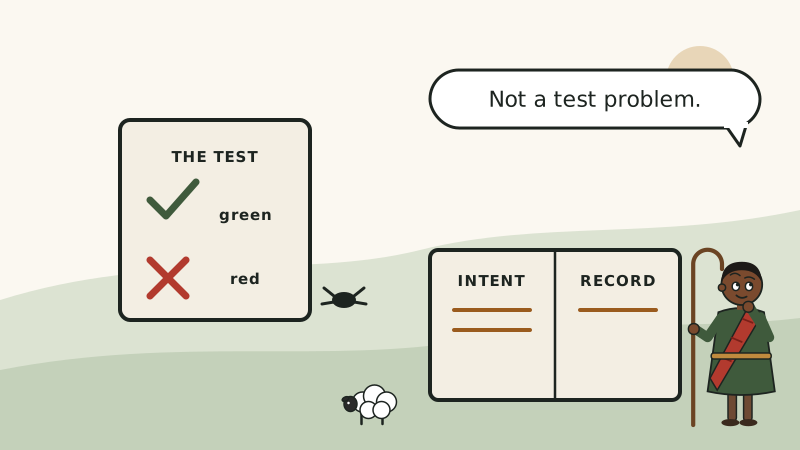
The cause was a real bug, not a test problem. The hub appends each change to the logbook, then records a hash of the file. When the hub stopped a helper, a check could die between those two steps. That left the logbook changed, the hash out of date, and a lock that never cleared. The hub then could not log its own stop, and it refused the next start.
Fixing a test would have hidden that.
The fix
Pull request 27 changed how the logbook writes:
- The hub writes its intent to a small file before it touches the logbook.
- It records the new hash only if the file is exactly what it intended to write.
- After a crash, it recovers only two exact states, and writes one recovery entry. Any other mismatch still counts as tampering and stops everything.
- The lock is a kernel lock, so it frees itself when the process dies, even after a kill -9.
- Stop signals wait until the write ends.
My review of that pull request:
- 906 tests passed on Python 3.11, 3.12 and 3.13.
- The two stop tests passed 20 of 20 runs with the processor under load.
- I wrote my own check: three writers append to one logbook and I kill them at a random moment. The next write succeeded, and the logbook verified clean, in 40 of 40 trials.
What I do not know yet
- On Nov 9 the hub had not run against a real Claude Code login or a real Kiro login. The first real runs were on Nov 15, one each for Claude Code, OpenCode and Kiro on one machine. The gate held in all three. The Claude Code run found a fault in how its cost report is read, and the fix is approved and not merged yet.
- Cost readings from Claude Code are estimates at list price. On a subscription they are not a bill.
- Known limits are listed in a file in the repository, and I keep adding to it.
What comes next
This was the plan on Nov 9. The login checks, the hash chain on the logbook, the spending limit across all tools, the whole-system check and the security scan were all merged by Nov 10, earlier than planned. What is left as of Nov 15:
- A fix for the Claude Code cost report, and a second round of real runs.
- A page that says plainly what the system is and is not.
- Nov 29 to Dec 2: freeze.
- Dec 3: the Kiroween submission.
Try the page I built for the Founding.dev design hackathon: https://umwayi-hub.foundingdev.com/ The code: https://github.com/Miguel-Shinyenyi/umwayi-os
If one of your AI helpers acted without asking, what should it have asked you first? Reply and tell me.
Comments