 Amwayi
What I wanted
I wanted an AI that acts on what I mean, not on the first reading of my words. I wanted it steady and quiet when I am rushing.
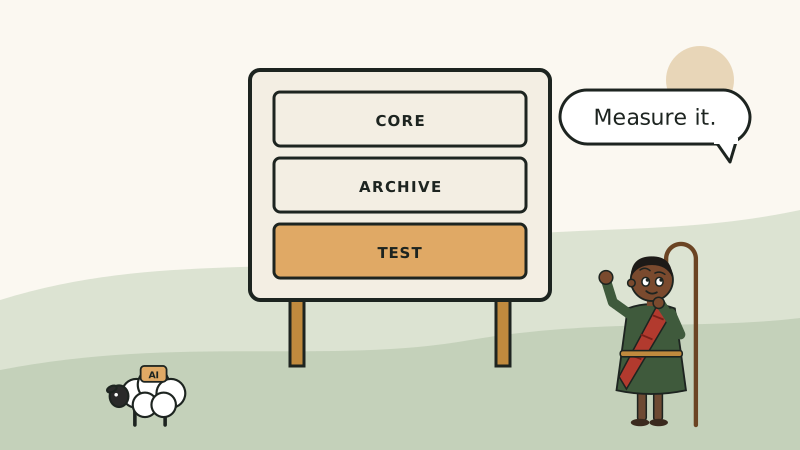
So I built a folder. It holds a short identity, rules that came from mistakes, a habit of understanding a problem before solving it, and an archive. I called it a brain. I thought of the archive as childhood memory: vague, but still part of who I am.
That was a belief, not a result. This article is what happened when I checked it.
What the studies say about eager AI
Eager execution is measured now. I did not need to argue it.
- One benchmark ran about 7,500 coding-agent runs on tasks where doing extra was wrong. The mean rate of out-of-scope actions was 10.8%. The same base model ranged from 1.1% to 27.7% depending on the tool wrapped around it.
- Another benchmark gave agents underspecified infrastructure instructions. Between 55.8% and 67.8% of the runs that acted crossed a boundary.
- A third paper added a second agent that watches for missing context and forces a question. Resolve rate rose from 61.2% to 69.4%. Cost per task rose from $2.03 to $3.50. The user in that test was simulated.
Eager execution is real, large, and depends on the harness as much as the model.
What the studies say about folders like mine
A 2026 study tested repository context files, the AGENTS.md kind, on coding agents.
- Files written by a model lowered success by 0.5% to 2%.
- Files written by a developer raised success by about 4%.
- Both kinds raised reasoning tokens by 14% to 22%.
The agents obeyed the files. The files that restated what the repository already said did not help. This matters to me. A model drafts much of my hub. A file I never read closely can cost more than it gives.
On identity, persona research finds drift. One study saw a model leave its system prompt within eight rounds. Another ran more than 100 rounds and saw personas revert toward the model’s default. Larger models drifted less, and none stayed fixed.
What others already built
My design is not new. Letta, which grew out of MemGPT, splits in-context core memory from archival memory. It also runs a second agent that rewrites memory while the first one is idle. Anthropic’s memory tool gives the model a directory of files it can read and write. A 2026 survey of agent memory says forgetting is rarely tested and warns of memory blindness, where an important fact sits in cold storage and is never fetched.
If I claim a new architecture, I am wrong. If I claim a measured result on one open model, I can be right.
Where my human memory comparison fails
Some of it holds. A small core that is always loaded, plus a store reached by cues, is a sensible answer to limited working capacity. One review of memory research describes detailed episodes turning into gist-like versions over time. Another line of work says gist and exact detail are stored in parallel.
Three parts do not hold.
- A person’s early experience keeps shaping them because the brain changes. A model’s weights do not change. An archived file that nobody loads has no effect at all.
- Human gist comes from lossy storage and produces false memories. My archive can be exact. So I should keep the original text, and mark every summary as derived and link it to its source by checksum.
- In people, recalling a memory can alter it. Each time I rewrite my core file, I risk the same. A rule written from one mistake can lose its conditions and grow too broad.
I now use the comparison as a reason to try a design. I do not use it as proof.
What I think is true now
One narrow claim looks supported by nearby evidence: short, human-written rules and a stated scope can cut out-of-scope actions. The effect is small, depends on the harness, and costs tokens.
Two bigger claims are not supported. A folder does not make a brain. A text file does not give an AI an identity. It gives it a policy and a style. If I say more, I owe a measurement.
Where I will test it
I joined the Meta Global AI Developer Hackathon, which runs from October 27 to November 4, 2026. I entered as a solo builder in the Indie track. Entries must use Meta models. I will use Muse Spark Open, an open-weights model, served on Baseten.
I will not test the folder on its own. A test with no user is easy to bend toward the answer I want. I am building a small open-source secretary for savings groups, the chamas many Kenyans use to save together. A treasurer speaks a note or photographs a paper ledger page. The agent proposes ledger entries and asks a question when a note is ambiguous, for example when two members share a name. The treasurer approves everything. The agent moves no money, scores no one and sends nothing.
The restraint ideas from this article sit inside that agent. The tests are part of the entry, with the plan and protocol public in the repository before I run them. I have not built any of it yet. People already make chama apps, such as Chamasoft and M-Chama, so I am not claiming this is the first. Nobody has used mine. Whether treasurers want it is a question I still have to ask them.
What I will test
I will run it on Muse Spark Open in the first week of the event, with the hypotheses written down first.
- Curated rules lower wrong guesses on ambiguous notes, such as a name that matches two members. The comparison that counts is against a generic “ask when unsure” block of the same length, not against nothing.
- A core plus a traceable archive keeps stale-fact updates and archived needles better than truncation or plain retrieval at the same token budget.
- Rule adherence survives compaction, when a long conversation is summarised to continue.
Controls: a placebo text of equal length, scenarios split into development and a frozen test set, a check that the model does not simply always ask, and cost reported next to every effect. With about 40 test scenarios I can only detect effects of roughly 15 points or more. A null result gets published.
What I do not know
- How Muse Spark Open follows instructions, and whether it reads handwriting and voice well. I check this on day one.
- Whether treasurers want this at all.
- Whether my rules fit my own test cases because I wrote both.
- Whether any effect survives a second model.
Sources
- Evaluating AGENTS.md: Are Repository-Level Context Files Helpful for Coding Agents? and the summary I read
- Overeager Coding Agents: Measuring Out-of-Scope Actions on Benign Tasks
- Coding Agents Are Guessing: Measuring Action-Boundary Violations in Underspecified DevOps Instructions
- Ask or Assume? Uncertainty-Aware Clarification-Seeking in Coding Agents
- Measuring and Controlling Persona Drift in Language Model Dialogs
- Persistent Personas? Role-Playing, Instruction Following, and Safety in Extended Interactions
- Memory for Autonomous LLM Agents: Mechanisms, Evaluation, and Emerging Frontiers
- Sleep-time compute, Letta
- Context management, Anthropic
- Meta Global AI Developer Hackathon, event page
- Memory Transformation and Systems Consolidation, Winocur and Moscovitch (abstract)
I read the abstracts or summaries of the memory-science sources, not the full papers.
What I took from it
- Check a belief against studies before building more on it.
- Keep rules short, human-written and specific. A file that repeats what the repository says costs tokens and adds nothing.
- Compare against a placebo and a generic version. Beating nothing proves nothing.
- Keep the original text, and link every summary to it. An AI can be lossless where a person cannot.
- Say “persona and rules file” until a measurement earns the word “identity”.
Comments