 Amwayi
The claim, as I understand it
This is my understanding of Part 2, Chapter 1 of Sapiens, “History’s Biggest Fraud”. It is not a checked account of the text.
As I read it, the chapter says farming did not make people smarter or their lives easier. The average farmer worked harder than the average forager and ate a narrower diet. The chapter blames a few plants: wheat, rice, potatoes. They planned nothing. But the people who tended them left more descendants, so the habit spread, and the plants now cover far more ground than before. People settled next to the fields and worked to keep them alive. In the chapter’s framing, the plants domesticated us.
I can check one part of this outside the book. Researchers compare skeletons from before and after farming arrived. I found two sources: a 2011 paper on stature and robusticity across the agricultural transition, and a review titled “Foraging to Farming Transition: Global Health Impacts, Trends, and Variation”. I could not open either. I only confirmed that they exist. Both titles point at health costs, and the second points at variation between regions. Treat that as a lead, not a finding.
Two numbers that moved apart
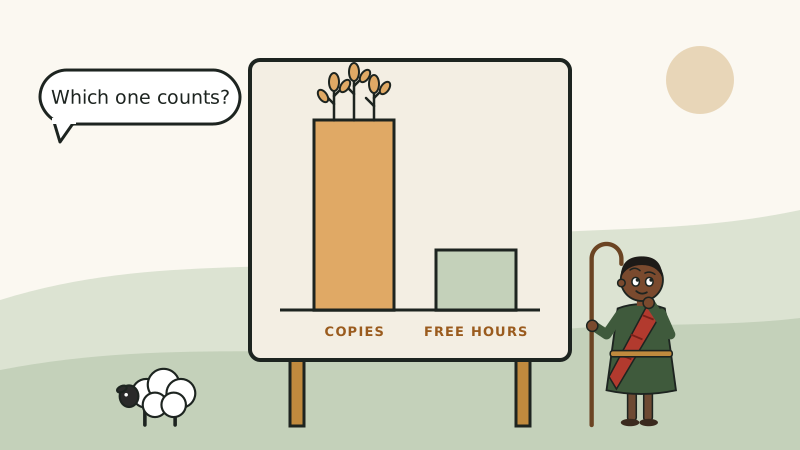
The chapter’s point, as I take it: evolution measures success in copies of DNA. More people means more copies. By that measure farming won, for the plants and for our species. The same measure has no column for how any one person’s life went.
Farming kept more people alive under worse conditions. Both halves of that sentence are true at once, because they count different things. One counts how many. The other counts how well.
The chapter also warns against judging thousands of years by how we live now. Today’s security and wealth sit on what farming made possible. A bad deal for the average farmer and a base for later life can both be true.
Where my company comparison holds
I compared it to a company. A company’s goal is to make money, not to keep its employees happy. Revenue can rise while happiness falls, because happiness is not in the number.
That is the same structure: one measure, and people it does not count.
Where it stops holding
Wheat cannot notice anything. A company has people in it who can notice the gap and close it. Some leaders treat employee happiness as a way to keep staff and raise output. Some treat it as a goal. Either way, a person decided. Evolution has nobody to decide.
So the version of the comparison I trust is smaller. A system judged by one number drifts away from the welfare of the people inside it, unless someone ties the two together on purpose.
A company whose growth and employee welfare both rise today has not shown that anyone tied them. They may be moving together for now. A test: when the number is threatened, what gets cut first? If employee welfare goes first, the tie was never there. I have not applied this test to any company yet.
What I am not sure about
I have not read the chapter’s figures on hours worked or diet. “Worked harder, ate worse” is the chapter’s claim to me, not one I checked. The skeleton evidence appears to vary by region, going by the titles alone.
Farming also gave us things foragers did not have: surplus, people who could stop growing food, writing, cities. “Fraud” describes one axis, the average person’s daily life. I do not know how to weigh it against the others, and I am not sure the chapter claims to.
What I took from it
- A system can win by its own measure while the people inside it lose by theirs. Ask what the number counts and what it leaves out.
- More is not better. Copies, revenue and output all count quantity.
- A comparison is useful until it stops fitting. Say where it stops. Here: wheat cannot choose, a company can.
- A measure lines up with people’s welfare on purpose only if something protects the link when protecting it costs. What gets cut first shows which one the system serves.
Comments