 Amwayi
Explain it cold, then check
Same method as idempotency: explain the mechanism from memory, then check it against the actual code, not the other way around. The point isn’t to be right on the first try. It’s that a claim about your own system should be falsifiable. If I can’t say what I’d expect to find in the code that would prove my explanation wrong, I’m not really explaining it, I’m just repeating a shape that sounds right.
Two subsystems, two different results. The outbox explanation held up once checked. The ledger explanation didn’t, not because the mechanism I described was wrong, but because the part of it I assumed existed simply wasn’t built yet.
What the outbox is actually for
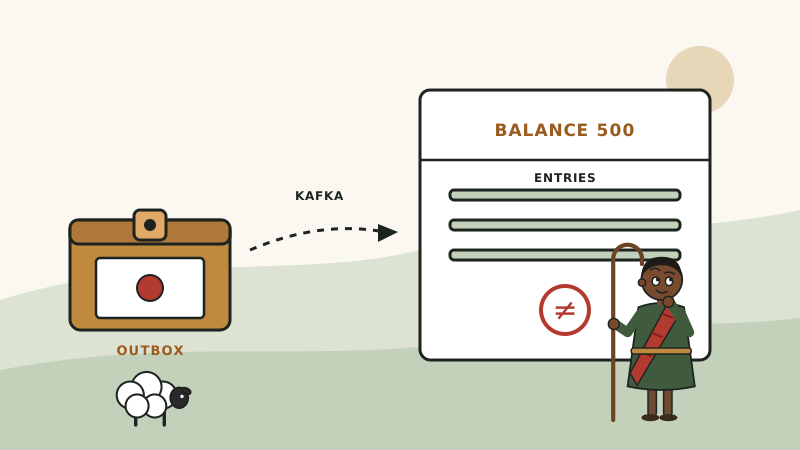
The instinct is to describe it as a receipt: proof you sent something, so you can resend it if it doesn’t land. That’s close, but backward. The real problem is that a database commit and a message published to Kafka are two separate systems, and you can’t make them one atomic operation. Publish first, then save to the database, and a crash in between means you told the world something happened that your own database never recorded. Save first, then publish, and a crash in between means your database says it happened but nobody downstream ever hears about it. Either order leaves a gap where the two systems can disagree.
The fix is to make the event write local, so it can share a transaction with the fact it’s describing:
@Transactional
public SettlementExecutionRequest createPendingSettlement(...) {
    ...
    settlementRepository.save(settlement);

    outboxWriter.write(AGGREGATE_TYPE_SETTLEMENT, settlementId, KafkaTopics.SETTLEMENT_REQUESTED,
            new SettlementRequestedEvent(settlementId, source.getId(), destination.getId(),
                    command.amount(), command.currency(), Instant.now()));
    ...
}
Same transaction, same database. The settlement and the event to announce it commit together or not at all. A separate process then polls for unpublished rows and sends them on, only marking a row done once the broker actually confirms it:
kafkaTemplate.send(event.getTopic(), event.getAggregateId().toString(), event.getPayload()).get();
event.markPublished();
If that send fails, the row just sits there, unpublished, and gets tried again next poll. What this buys isn’t proof after the fact. It’s a guarantee that the event and the thing it describes can never come apart: if the settlement never happened, no event exists to send. If it did happen, the event goes out eventually, whatever crashes in between.
What double-entry is supposed to guarantee, and what wasn’t there
Double-entry means every transaction writes two sides, a debit somewhere and a credit somewhere else, and across any transaction the two must net to zero. The point of doing it this way is that a balance stops being something you just trust. It becomes something you can prove, by summing the entries that produced it.
The code writes both sides correctly:
source.debit(settlement.getAmount());
destination.credit(settlement.getAmount());
ledgerEntryRepository.save(new LedgerEntry(UUID.randomUUID(), settlementId, source.getId(),
        EntryType.DEBIT, settlement.getAmount()));
ledgerEntryRepository.save(new LedgerEntry(UUID.randomUUID(), settlementId, destination.getId(),
        EntryType.CREDIT, settlement.getAmount()));
But balance is also a stored column, mutated directly by debit()/credit() in that same
method. And this is the whole repository interface for the entries just written:
public interface LedgerEntryRepository extends JpaRepository<LedgerEntry, UUID> {
}
No query beyond what comes free. Nothing anywhere sums those entries back and checks them against the balance. The entries were being written correctly and never read. A ledger that nobody checks isn’t really double-entry, it’s an audit trail sitting next to a number everyone just trusts.
Deciding what happens when it’s wrong
Finding the gap is the easy part. The harder question is what a mismatch should actually do once the system can see one.
The tempting answer is to auto-correct: recompute the balance from the entries and overwrite
it. That’s the wrong incentive to build into the system. A mismatch means you don’t yet know
which number is wrong, the stored balance or an entry. Auto-fixing assumes an answer you
don’t have, and it means a real bug gets silently absorbed instead of surfaced, which is
exactly how a system keeps producing the same kind of failure: nothing about the mismatch
ever reaches whoever could actually fix the cause. docs/reconciliation.md already states
this as policy for a different case, mismatches with an external gateway: manual review by
default, no silent auto-resolution. That’s not a rule specific to talking to a bank. It’s the
right rule for any internal disagreement a system can detect but can’t safely resolve on its
own, so it’s now written that way, a general rule with two implementations rather than one
rule that only happens to apply once.
The fix: every account gets an opening entry so its balance always equals the sum of its own history, and a check runs on every read. On a disagreement, it records the mismatch, once, durably, and still refuses to hand back a number it doesn’t trust:
public void verify(LedgerAccount account) {
    BigDecimal computed = ledgerEntryRepository.sumNetByAccountId(account.getId());
    BigDecimal stored = account.getBalance();
    if (stored.compareTo(computed) == 0) {
        return;
    }
    if (ledgerMismatchRepository.findByAccountIdAndResolutionStatus(account.getId(), OPEN).isEmpty()) {
        ledgerMismatchRepository.save(new LedgerMismatch(...));
    }
    throw new LedgerInconsistencyException(account.getId(), stored, computed);
}
Resolving that record later never touches the balance either. It records that a human looked at it and made a decision, the same as the existing gateway-mismatch workflow. Verified against real data before calling it done: forty-six settlements moved through the actual API, every untouched account’s backfilled history matched its original balance exactly, and one account whose balance was hand-edited to disagree with its own history was caught, flagged, and resolved without its balance being touched by the fix itself.
What I took from it
- A claim about your own system should be falsifiable. If nothing in the code could prove it wrong, it isn’t really an explanation.
- The outbox isn’t proof you sent something. It’s a guarantee that an event and the fact it describes can never come apart.
- Entries that are only ever written and never read aren’t a checked ledger, whatever they’re called.
- When a system finds its own mistake, the honest move is to record it and ask, not to quietly fix it and move on.
Comments